

New month, new potpourri. You should know the drill by now if you’ve been reading for a while, but to you new people, I set aside the first Media Monday of the month to do a BIG roundup of media that influences my creative spirit, one each of my four main categories: book, movie/tv, music, game. I try to pick stuff that I don’t see discussed much so that maybe you can discover something new.
While my promo IS for sale, all of the items discussed here are of my own volition.
Book: The Cactus League by Emily Nemens

Baseball is such a romantic sport. I think it’s easy to dismiss it as boring because there are long stretches of a game where guys just seem to stand around; but underneath that there’s all these cerebral angst. The pitcher is launching a rock-hard ball of rawhide at another man, baiting him into missing it. The batter stares down the pitcher, trying to read his mind, hoping to drill the ball into the next county with a mighty swing. There’s nothing like the sound of a crack of a wooden bat as it strikes its target. The crowd holds its collective breath hoping the ball will indeed make it into the next county, or at least the stands…or perhaps not, if its the visiting team. The fielders rush into action to stop this from happening by any means necessary. Then it’s back to try again, until the pitcher has gotten three batters out.
The human mind is built to understand cycles, and baseball is a game of cycles in the micro of the pitcher-versus-batter and in the macro of generations-long clubs. You’ll hear old-timers explain that baseball is a metaphor for live; it’s practically a cliche. And it is so for a reason.
Emily Nemens’s novel about a group of fictional players and the world that springs up around them understands the romance of the sport. Told as a stories of vignettes from nine different characters’ points-of-view, you learn the dramas of the team in the micro of the player and the macro of the entire club. I don’t think you need to enjoy watching baseball to enjoy the story—the sport is just a framework for the emotions at play—but I do think you’ll appreciate it more if you have affection for the game. Emily gets into the minds of players, owners, agents, and the lovers of these men and builds an interconnected narrative using elegant prose I envy. A quick book that was one of my favorite reads of the last year.
TV: Quantum Leap (1989)
I’m surprised I don’t see Quantum Leap get the same kind of love shows like X-Files and The Next Generation get. It’s not exactly an under-the-radar show, as it did end up getting a remake/reboot (continuation?) right around the time COVID hit, but when it comes to geeky popculture zeitgeist, it never seems to top anyone’s lists.
Sam Beckett, played by Scott Bakula, is a quantum scientist who has unlocked the secrets of time travel. When testing his machine, get gets trapped in the time, with his only link to his present being Al Calavicci, a smarmy wiseacre admiral played by Dean Stockwell. Sam is trying to find his way home, and no one is quite sure how to get him there.
As it turns out, Sam has “traded places” with someone in the past. Using an AI named Ziggy, Sam’s best hope for getting home seems to be helping the person with whom he has swapped. Once he has helped his target, he leaps into another person to help and so on. They figure that once he “sets right what once went wrong” enough times, he will finally make it back home.
Maybe this sounds a little hokey. I guess it kind of is. But the show examines some really interesting scenarios: Sam jumps into a black man in one episode and tries to help a girl in a car accident…but because he’s in the 60s in the south, getting help from the white people in town is no easy feat. In another episode, he jumps into a woman’s body and has to battle with corporate sexism—the boss is much more interested in her body than her design ideas. In yet another, Sam finds himself in Vietnam as part of his brother’s SEAL team. Sam is supposed to be helping his soldier survive a coming raid…but that means allowing his brother to die. He grapples with trying to solve his time travel dilemma and saving his brother instead. “You’ll change the future if you go off mission!” Al argues. “Aren’t I changing the future anyway?” Sam bites back.
The effects are dated, but the storylines are surprisingly modern. By today’s standards, Quantum Leap is extremely “woke” and makes statements on race and gender that in many ways seem more open-minded than today’s TV. This, combined with the creative plotting, made binge-watching Quantum Leap earlier this year a joy. The show definitely holds up, even as it goes on forty years old.
Music: Memoir by Downtown Binary
I don’t write about synthwave music much because I think it’s one of those like-it-or-don’t things. I listen to instrumental music a lot at work because lyrics will distract me while I’m trying to program or write. But Downtown Binary is one of my favorite artists in the space.
The UK-based composer sequences gentle pads and beats that have energy without being frenetic. It’s good for flowstate work, like writing, or puzzle gaming, or even jumping rope. The track Depth is one of my favorite songs period, and a favorite way to end a jump-rope work out with its cool-down rhythm. I frequently throw this album on when it’s time to lock in.
Game: Terror of Hemasaurus
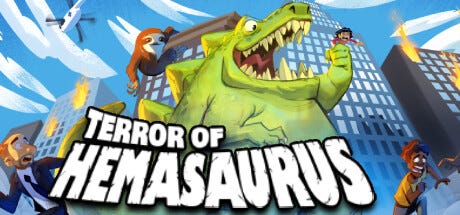
When I was a lad, I was fond of game called Rampage. It’s an homage to kaiju films like King Kong and Godzilla and the premise is simple: you play as George the Giant Ape or Lizzie the Giant (get this) Lizard and knockdown all the buildings on the screen. Local law enforcement and eventually the national guard get involved to try to stop you as you go about leveling America.
Terror of Hemasaurus is a spiritual successor of rampage. It’s an admittedly simple game where all you need to do is knock down buildings, stopping only to nom some civilians if your health gets too low. But there’s something endlessly satisfying about kicking a station wagon into a helicopter, causing it to careen in to a building that then falls over on another building. Maybe dinosaurs went extinct because they were just having too good of a time.